

Short answer
Spreadsheets may seem like a simple, inexpensive way to track Title IX, BIT/CARE, student conduct, incidents, and HR investigations in K-12 and higher education. As case volume grows, though, spreadsheets can’t keep up, creating serious risk for institutions. An education case management platform instead gives you one secure source of truth, standardized workflows, and a complete audit history.
Case management teams across K-12 and higher education are facing a challenge. Over the last several years, they have had to take on more compliance responsibilities related to Title IX, student conduct, threat assessment, incident reporting, and more. Despite these compliance responsibilities, many teams are still managing cases manually, in spreadsheets, shared drives, and emails, creating inefficiency and risk.
In our recent webinar, Guardian President Todd Tribble, explored why manual processes no longer work and why adopting an education case management platform is the best solution. Keep reading to explore our webinar recap, or watch the replay below.
The Reality Facing Case Management Teams
Over the last five to ten years, there has been an influx of compliance brought into education, including Title IX, threat assessment, incident reporting, and employee relations in K-12 and higher education.
The list keeps growing. In college athletics, the name-image-likeness (NIL) rules are becoming a prevalent compliance area. There is also a parenting component, where institutions now face compliance questions around what they offer young parents and what they offer accessibility-wise.
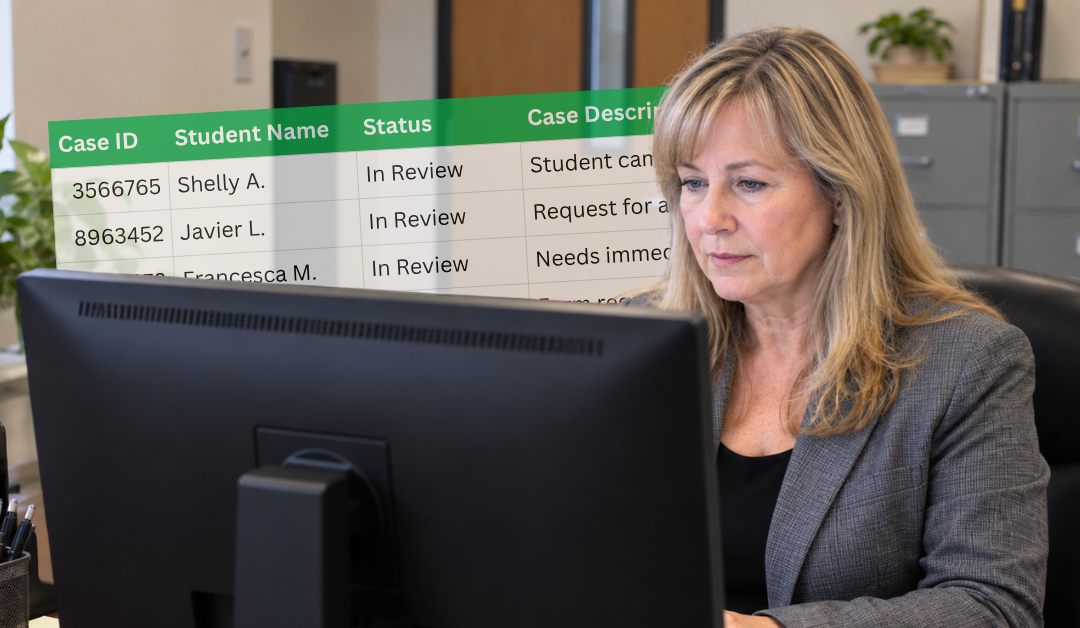
Institutions are facing a lot of different case management needs, but the problem is that many are still relying on manual ways of managing cases, such as using Excel spreadsheets, shared drives, email folders, and sticky notes. Modern responsibilities are being managed by yesterday’s tools, and people feel that.
Why Spreadsheets Become the Default in Case Management
Most people do not set out to run their operation on spreadsheets. Instead, a need appears, someone volunteers or is told to take it on, and the work has to get done. That person quickly needs a way to get cases into some kind of organized fashion.
Spreadsheets become the easiest way to start. They are usually a familiar platform someone has used before, they are inexpensive because you’re not buying a new tool, and they are flexible, so you can set them up however you want. At the outset, you feel like you are getting the result you want based on what is being asked of you.
When a Small Caseload Becomes Expansive
Normally the people managing K-12 or higher education cases do a very good job. Over time, though, it becomes unmanageable. Word gets out that someone is handling cases well, and others start saying they need to add their cases in the spreadsheet or folder, too. The caseload you thought was small keeps growing as people bring in issues you did not even know existed.
You are still trying to manage cases in the spreadsheet, and you are already too far in to change course. More staff comes in, more parts of the school or district get involved, and the complexity builds. Now Title IX is in one place, conduct is in another, and threat assessment is somewhere else, each with different tabs, different cases, and different needs. As that takes hold, you are creating a serious amount of operational risk.
The Hidden Costs of Managing Cases Manually
There are many hidden costs to managing Title IX, student cases, and employee investigations manually, but a few stand out.
Limited Audit Trail
The biggest one on the risk side is the limited audit trail. Every case is sensitive, but eventually you get one serious enough that your whole office takes notice. That is the one that gets audited, because more people get involved. If you are running that through a manual system and you lose visibility, lose the documentation, or lose the ability to walk through it, your audit risk becomes very large. When leadership comes back and asks for a case summary, you are exposed.
Email Overload and Manual Reminders
On efficiency, email overload and manual reminders become untenable. When email is your method of communication, you are constantly building folders, then pulling from those folders into the spreadsheet, and the ability to lose things is huge.
Reporting
Then there is reporting. You can do reporting out of a spreadsheet, and some people are very good at it, but the sharing of that reporting, getting multiple eyeballs on it, and exporting it securely is where things get weak. Executive reporting, such as a monthly summary on the superintendent’s desk, becomes a real time sink. Trend analysis, meaning seeing whether your prevention efforts are working over a three-year window, is critical but one of the hardest things to get behind manually.
Burnout and the Single Point of Failure
Finally, there is burnout and the single point of failure. The case manager role is important, but it can be extremely stressful and labor-intensive, and burnout naturally occurs. Often you have one person who is really good at spreadsheets and knows where everything is. If that person leaves, it is catastrophic, and the learning curve to replace them can run months. That puts you right back in a risk scenario.
What Spreadsheet Management Looks Like Day to Day
Every day, a complaint email arrives, and the information gets copied into a spreadsheet. Documents are saved separately, a follow-up reminder is manually entered, an investigator updates the spreadsheet status, and an email goes to leadership. Then the whole cycle repeats dozens of times.
If this looks familiar, take that flow and map it to your own operation to find your gaps. The documents saved separately are a common one. A frequent complaint is having documents in various spots, so you need to know the four or five places to go to compile what you need. The investigator update is another. Without a common intake spot that captures information in real time, an investigator takes notes, goes on with their day, and comes back Friday to enter them three days later. That delay is not just lost information. It is a compliance issue.
What Modern Case Management Should Deliver
A modern case management system for K-12 and higher education offers several benefits, solving the issues that manual spreadsheets and files create.
One Secure Source of Truth
This is the most critical piece. A modern case management platform gives your district or institution one source of truth for all cases. Being able to say “if it is not in here, it does not count” is powerful, because every team will use that one platform, creating a more efficient and secure way to manage cases.
Standardized Workflows
You need standardized workflows, along with different workflows for each part of the case management world. A Title IX workflow can look very different from what a BIT/CARE team needs. For instance, many existing platforms are built just for student conduct, so teams such as Title IX or another department end up forcing their way in or opting out entirely.
Automated Notifications
You need a platform that tells you when there is a change related to a case. Automated notifications help ensure you respond to cases on time, stay compliant and provide necessary supports to students.
Secure Documentation
When someone uploads important information, it has to be secured, it has to stay where you expect, and it has to be tied to the right case. This is especially true for sensitive cases.
Real-Time Reporting
Cases are constantly shifting, sometimes within days. Being able to see that data shift in real time is critical. You may not realize you need it until you see it.
Complete Audit History
This goes back to the number one risk. A complete audit history protects everyone, including the students, yourself, and your institution. The protection piece is everything.
Role-Based Permissions
You do not want everyone having access to everything, since that is a compliance nightmare. The right permissions give you security and comfort, and they build trust. People only submit sensitive intakes when they trust that what you have set up will protect them.
Cross-Functional Collaboration
Teams need to collaborate, see cases the right way, and move an incident appropriately through the process, all within the right role-based permissions.
Measuring the Operational Impact
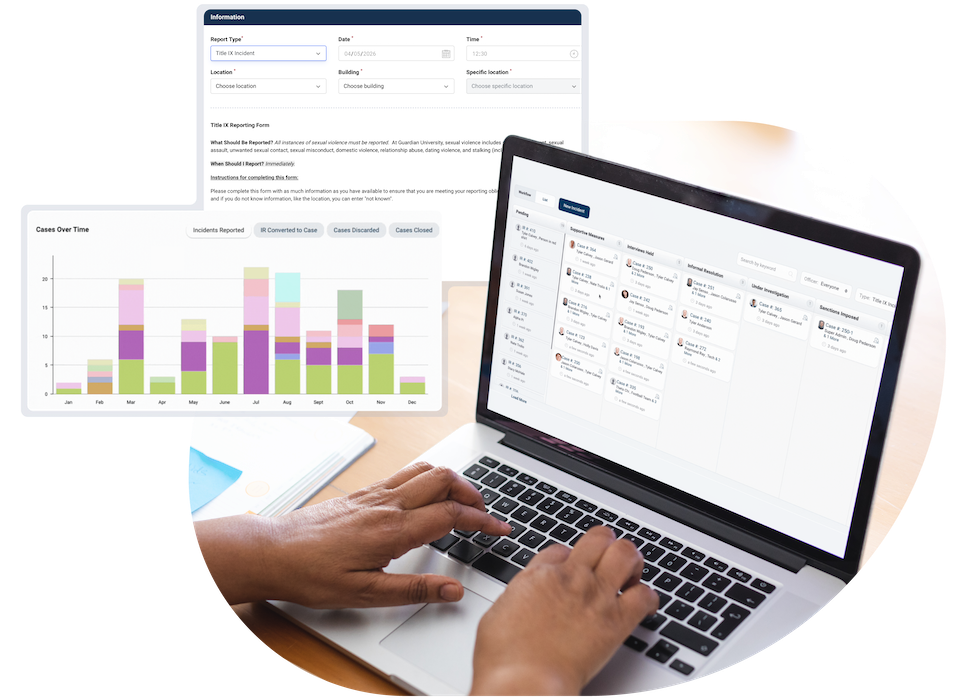
When you compare spreadsheets and a modern case management platform side by side, the contrast is clear. Multiple spreadsheets become a single platform. Manual reminders become automated workflows. Email searches become centralized records. Individual reporting becomes executive dashboards.
If you are working within a spreadsheet or a manual process, you are probably in reactive mode. Something happens, and then you are reacting to it, constantly in that motion. Proactive visibility flips that. You can start flagging repeat people who come in on incidents, spot behavior patterns, and get ahead of issues before they escalate. Proactive work and prevention go hand in hand, because reactive situations are very hard to prevent. If you can see what is coming, prevention becomes possible.
Why Guardian Is The Best Option for Case Management
Guardian is the best case management platform for K-12 and higher education. It supports:
- Title IX
- Student conduct
- BIT/CARE teams and threat assessment
- Incident reporting/Clery Act reporting
- Employee investigations
- Student support
K-12 districts and higher education institutions choose Guardian for three main reasons:
- Purpose built: Designed specifically for higher education and K-12 case management. It’s not adapted from generic CRM software.
- Configurable: Supports each institution’s policies, workflows, forms, and approval processes.
- Partnership: A client-first culture focused on implementation, support, and long-term success.
Before you decide whether you need a platform, ask yourself a few questions:
- How much staff time is spent updating spreadsheets each week?
- What would happen if that key employee left tomorrow?
- How quickly can leadership answer questions about open cases?
- Can you scale this?
Case management is not going to get less demanding. It is only going to ramp up. Guardian helps you take on the demands of education case management by protecting your students, supporting your staff, and ensuring you stay compliant.
To see Guardian in action, schedule a personalized walkthrough.
See How Guardian Simplifies Case Management
One secure, configurable platform for Title IX, HR, and Student Services compliance.
Frequently Asked Questions
Why don’t spreadsheets work well for case management in K-12 and higher education?
Spreadsheets can work when teams have a low number of cases, but as case loads grow, spreadsheets create compliance risk, especially related to sensitive cases.
What should a modern case management platform include?
A modern education case management platform should be a secure source of truth. It should also include configurable workflows for different departments, automated notifications, secure documentation, real-time reporting, a complete audit history, role-based permissions, and allow for cross-functional collaboration.
Why does an audit trail matter in K-12 and higher education case management?
Sensitive cases such as Title IX investigations are likely to be audited. A complete audit history protects students, staff, and the institution by showing the complete investigation and response.
What makes Guardian different?
Guardian is a purpose-built education case management platform, helping K-12 districts and higher education institutions. It works across Title IX, student conduct, BIT/CARE, threat assessment, incident reporting, and HR.
